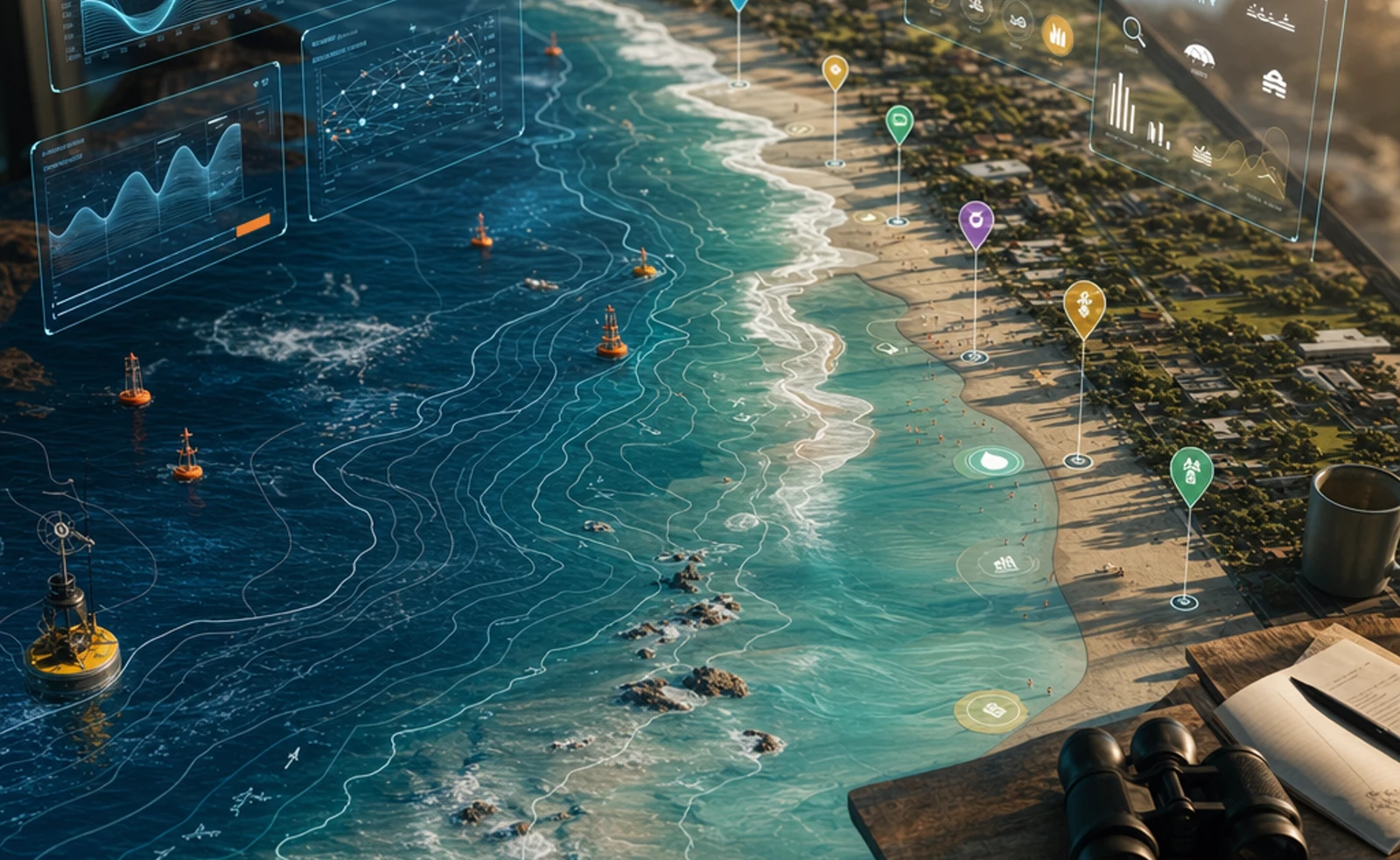
If you are evaluating coastal data vendors, the real question is not whether a marine weather API can return wind or waves. It usually can. The question is whether that is enough to power a beach-aware product. In most cases, it is not. Beach Day API is built for beach decisions, which means it combines beach identity, water quality, advisories, amenities, and a decision-ready score with the weather and ocean context developers already expect.
This comparison uses a real Beach Day API sample for Bondi Beach, Australia to show the difference in practical product output. A marine weather API is useful when your application only needs offshore or nearshore conditions. Beach Day API is more useful when your product needs to answer a beach-specific question like should we recommend this beach today? or which nearby beach is the best option right now? You can inspect the same endpoint family in the docs, review current credit costs on the pricing page, and see broader product positioning on the coverage page.
The core difference
A marine weather API usually answers condition questions about the water and atmosphere. That includes fields like wind, temperature, waves, swell, tide, or forecast timing. Those are useful signals, but they are not a complete beach product by themselves.
A beach API needs to answer a broader set of questions:
- Which beach is this, exactly?
- What nearby beach should the user consider instead?
- Is there any water quality or advisory context?
- Are there amenities or access details that matter for a family, guest, or visitor?
- Can the product rank beaches instead of just displaying raw marine conditions?
That is why weather alone is often not enough for travel apps, vacation rental products, tourism pages, and beach recommendation workflows. A marine weather API gives you important signals. Beach Day API gives you a beach decision layer.
What Beach Day API returns that a marine weather API usually does not
For this run, we polled the live API with a user key and saved the raw samples in the draft bundle. The beach detail record for Bondi Beach returned a mix of identity, water quality, weather, ocean conditions, and a top-level score:
{
  "id": 1707,
  "name": "Bondi Beach",
  "state": "AU-NSW",
  "country": "Australia",
  "county": "Waverley Council",
  "city": "Sydney City",
  "beach_day_score": 79.0,
  "water_quality": {
    "grade": "A",
    "source": "NSW BeachWatch",
    "updated": "2026-08-10",
    "advisory": null,
    "bacteria_level": "Unlikely"
  },
  "weather": {
    "temp_f": 56.7,
    "humidity": 68,
    "uv_index": 0.0,
    "wind_mph": 52.3,
    "condition": "partly_cloudy"
  },
  "ocean_conditions": {
    "water_temp_f": 64.8,
    "wave_direction": 58,
    "wave_height_ft": 2.8,
    "wave_period_sec": 7.7
  },
  "rules": [],
  "amenities": []
}
That is a very different object from a pure marine weather response. It still includes the condition signals a weather-oriented integration would care about, but it adds the beach-specific context that helps a product make decisions instead of just showing metrics.
Why that matters in product terms
If you are building a surf dashboard, offshore planning tool, or boating workflow, a marine weather API may be enough. If you are building a beach-facing experience, it often leaves too much work to the application layer.
Consider the difference in downstream product logic:
- Marine weather API: fetch wave, wind, and tide data, then figure out which shoreline location it belongs to, whether water quality matters, and how to rank one beach against another.
- Beach Day API: fetch a beach record that already carries beach identity, current score, quality context, and condition fields in one response shape.
That cuts down integration work for any product where the user thinks in terms of beaches, not grid cells or buoy coordinates.
A marine weather API is strong at physics, not beach context
This is not an argument that marine weather APIs are bad. They are strong at what they are built for. They often provide excellent environmental signal depth, forecast granularity, and geospatial coverage.
The mismatch happens when teams try to use them as a complete beach product backend. At that point, developers still need to solve several additional problems:
- normalize beach names and locations
- map condition points to actual beaches
- source water quality or advisories separately
- attach amenity or access context
- create a ranking or recommendation layer
Beach Day API exists to reduce that stitching work.
The conditions endpoint shows why this matters for trend-aware apps
The live conditions endpoint for the same beach returned dated snapshots with the same nested structure:
{
  "beach_id": 1707,
  "count": 8,
  "results": [
    {
      "date": "2026-08-10",
      "water_quality": {
        "grade": "A",
        "source": "NSW BeachWatch",
        "advisory": null
      },
      "weather": {
        "temp_f": 56.7,
        "wind_mph": 52.3,
        "condition": "partly_cloudy"
      },
      "ocean_conditions": {
        "water_temp_f": 64.8,
        "wave_height_ft": 2.8,
        "wave_period_sec": 7.7
      },
      "beach_day_score": 79.0
    },
    {
      "date": "2026-08-03",
      "water_quality": {
        "grade": "A",
        "source": "NSW BeachWatch",
        "advisory": null
      },
      "weather": {
        "temp_f": 47.5,
        "wind_mph": 14.3,
        "condition": "clear"
      },
      "ocean_conditions": {
        "water_temp_f": 65.7,
        "wave_height_ft": 2.4,
        "wave_period_sec": 10.95
      },
      "beach_day_score": 82.0
    }
  ]
}
For a developer, that means the same integration can support a beach detail page, a trend chart, a recommendation engine, or an alerting workflow. You are not only getting marine conditions. You are getting conditions attached to a beach entity and packaged in a way that supports decision logic.
When a marine weather API is enough
A marine weather API is a good fit when your product mostly needs environmental conditions and does not care much about beach identity or on-the-ground visitor context.
- boating and marine operations tools
- surf forecast products focused on wave behavior
- offshore monitoring dashboards
- general weather analysis pipelines
In those cases, the product is primarily modeling conditions, not helping someone choose among beaches.
When a beach API is the better fit
Beach Day API is the better fit when the product decision starts with a beach and needs more than weather alone.
- Travel apps: rank nearby beaches based on current score and practical conditions.
- Vacation rental products: turn nearby beach data into guest recommendations or daily updates.
- Tourism websites and city guides: add live beach context to destination pages instead of publishing static beach copy.
- Recommendation tools: use a unified score, water quality, and conditions object for comparison logic.
If your product surfaces coastal destinations, nearby beaches, or guest guidance, weather alone is usually not enough. That is exactly the gap Beach Day API is designed to close.
What technical buyers should compare directly
If you are deciding between a beach API and a marine weather API, compare the products on workflow outcomes, not just field count.
- Entity model: does the API return beach objects or only weather points?
- Water quality and advisories: are those included, absent, or left for you to source elsewhere?
- Decision layer: do you get a score or ranking-friendly object, or only raw conditions?
- Amenity and access context: can the API support destination pages and guest-facing guidance?
- Integration complexity: how much normalization do you still need to build after the first successful call?
That comparison is usually more useful than asking which API has the largest forecast payload.
A practical evaluation flow
- Call
GET /v1/beaches/?search=Bondi&country=Australia&limit=1to find the beach ID. - Call
GET /v1/beaches/1707/to inspect the full beach object. - Call
GET /v1/beaches/1707/conditions/?limit=2to review dated snapshots. - Then ask what would still be missing if you only had a marine weather response.
That test makes the difference obvious very quickly. Beach Day API is not trying to replace every weather-oriented workflow. It is trying to make beach-aware product decisions much easier to ship.
Bottom line
A marine weather API tells you a lot about the water and air. Beach Day API tells you whether a specific beach is a good product recommendation today, and gives you the surrounding context to explain why. If your application needs beach identity, water quality, advisories, practical amenities, and ranking-ready output in one place, a beach API is the better fit.